Device Signing Verifier node
The Device Signing Verifier node verifies possession of a registered bound device.
What are the differences between device binding/signing and WebAuthn?
There are many similarities between WebAuthn and device binding and JWS verification. We provide authentication nodes to implement both technologies in your journeys.
Both can be used for usernameless and passwordless authentication, they both use public key cryptography, and both can be used as part of a multi-factor authentication journey.
One major difference is that with device binding, the private key never leaves the device.
With WebAuthn, there is a possibility that the private key is synchronized across client devices because of Passkey support, which may be undesirable for your organization.
For details of the differences, refer to the following table:
| Feature | WebAuthn / FIDO | Device Binding / JWS Verifier | Details |
|---|---|---|---|
Industry-standards based |
✅ |
❌ |
You can refer to the WebAuthn W3C specification. Device binding and JWS verification are proprietary implementations. |
Public key cryptography |
✅ |
✅ |
Both methods use Public key cryptography. |
Usernameless support |
✅ |
✅ |
After registration, the username can be stored in the device and obtained during authentication without the user having to enter their credentials. |
Keys are bound to the device |
❌ |
✅ |
With WebAuthn, if Passkeys are used, they can be shared across devices. With device binding, the private keys do not leave the device. |
Sign custom data |
❌ |
✅ |
With device binding, you can:
|
Format of signed data |
|||
Integration |
❌ |
✅ |
With device binding, after verification, the signed JWT is available in:
This enables the data within to be used for integration into your processes and business logic. |
Platform support |
✅ Android ✅ iOS ✅ Web browsers |
✅ Android ✅ iOS ❌ Web browsers |
As it is challenging to store secure data in a browser as a client app, device binding is not supported in web browsers. |
Authenticator support |
Determined by the platform. Configuration limited to:
|
Determined by the authentication node. Full configuration options:
|
With device binding, you can specify what authentication action the user must perform to get access to the private keys. This provides greater flexibility in your security implementation and can reduce authentication friction for your users. |
Key storage |
Web browsers and iOS synchronize to the cloud. Android has the option to synchronize to the cloud. |
|
Both technologies store the private keys securely on the client. WebAuthn supports synchronizing the private keys to the cloud for use on other devices. This can reduce authentication friction for your users but may also increase the risk of a breach. |
Managing device keys |
Managed by the device OS. Apps cannot delete local client keys programmatically and do not have a reference to the remote server key for deletion. |
Managed by the Ping SDKs. Provides an interface to delete local client and remote server keys. |
The ability to programmatically delete both client and server keys can greatly simplify the process of registering a new device if an old device is lost or stolen. |
Passkey support |
✅ |
❌ |
WebAuthn supports synchronizing the private keys to the cloud for use on other devices. Device binding keeps the private key locked in the device. |
App integrity verification |
|
Not provided by the device binding or verification nodes. It can be added as part of the journey by using app integrity nodes. |
App integrity verification helps ensure your users are only using a supported app rather than a third-party or potentially malicious version. |
Key attestation |
|
|
Key attestation verifies that the private key is valid and correct, is not forged, and was not created in an insecure manner. |
Complexity |
Medium |
Low |
WebAuthn requires a bit more configuration, for example, creating and uploading the Device binding only requires the journey and the SDK built into your app. |
The node requires the device to sign a challenge string using the private key that corresponds to a stored public key.
The user might need to unlock their cryptography keys with biometric security — such as a fingerprint — or a PIN.
|
This node can be used in usernameless authentication flows. The Ping SDKs store and provide the identity when handling the callbacks from this node. If the device has been registered by more than one user, the SDK displays a list of the registered keys to choose from on the client device. Learn more about using this node with the Ping SDKs for Android and iOS in Implement device binding. |
Example
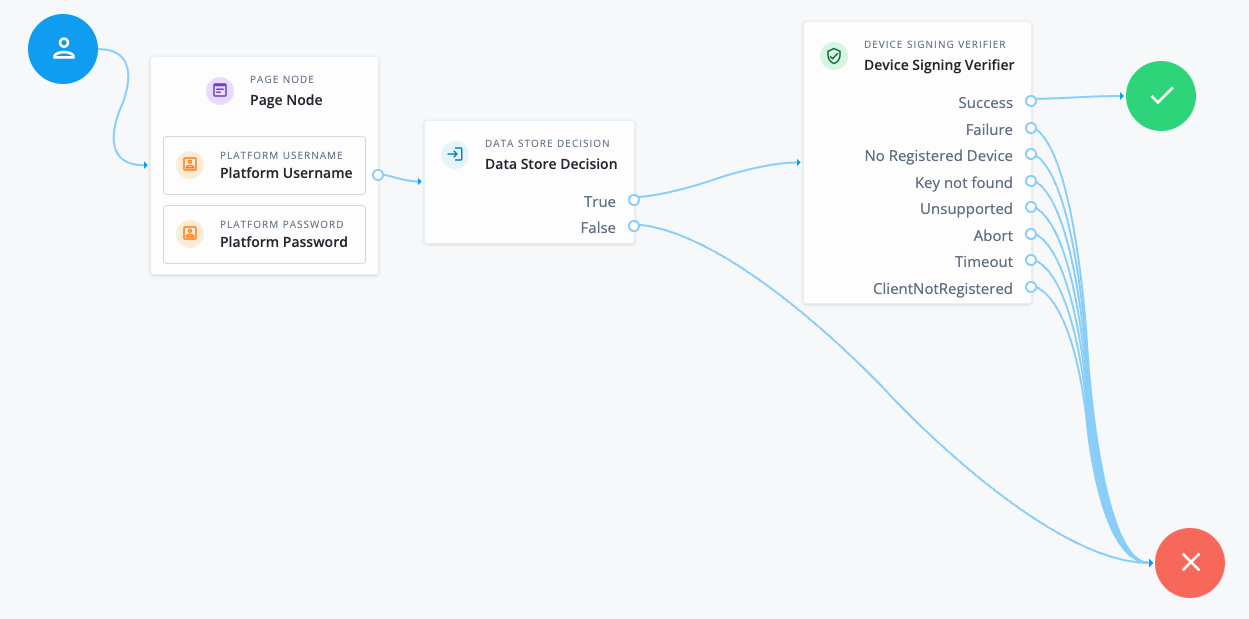
This example demonstrates using the Device Signing Verifier node to perform multi-factor authentication (MFA) after a user has authenticated with their username and password.
-
The Page node containing the Platform Username node and Platform Password node prompts for credentials.
-
The Data Store Decision node validates the username-password credentials.
-
The Device Signing Verifier node challenges the user to prove possession of a bound device. The user must unlock the private key on their device, for example, by using biometrics.
-
If the user successfully signs the challenge, evaluation continues along the
Successoutcome path, and the user is authenticated. -
If the user fails to sign the challenge, evaluation continues along the
Failureoutcome path. -
If the user has no devices registered, evaluation continues along the
No Registered Deviceoutcome path. This path could lead to a device registration flow using the Device Binding node.
-
Availability
| Product | Available? |
|---|---|
PingOne Advanced Identity Cloud |
Yes |
PingAM (self-managed) |
Yes |
Ping Identity Platform (self-managed) |
Yes |
Inputs
If you want the device to sign a custom challenge, its value must be available in shared state. Enter the variable name in the Shared state attribute for Challenge property.
Dependencies
This node requires that you have bound devices using the Device Binding node.
Configuration
| Property | Usage |
|---|---|
Sign Random Challenge |
Select this option to use a random value as the challenge for signing. |
Shared state attribute for Challenge |
Use the value from the named attribute in shared state as the challenge for signing. |
Application IDs |
The Android package names and iOS bundle IDs of applications that are allowed to perform device binding. For example, |
Title |
(Optional) Add a title to display to the user when asking them to bind the device. Add instructions
Leave blank to use the default message.(2) |
Subtitle |
(Optional) Add a subtitle to display to the user when asking them to bind the device. Add instructions
Leave blank to use the default message.(2) |
Description |
(Optional) Add descriptive text to display to the user when asking them to bind the device. Add instructions
Leave blank to use the default message.(2) |
Timeout |
The number of seconds to wait for a response from the client during binding. If the specified time is reached, evaluation continues along the |
Capture Failure |
Select this option to add the failure reason to the shared state variable If not enabled, the journey halts with an exception, and the journey does not continue along an outcome path. Reasons for failure include:
|
Client Error Outcomes |
The client error outcomes available to this node. Find more information in Error handling. |
(1) Specify a
locale that Java supports, such as en-gb. Otherwise, the node throws a configuration exception with an Invalid locale provided message.
(2) Learn more about customizing and translating default messages in Internationalize nodes.
Outputs
If you enable the Capture Failure property, the node outputs a failure reason string in a variable named DeviceSigningVerifierNode.FAILURE.
Callbacks
The node sends a DeviceSigningVerifierCallback, prompting the device to sign the challenge with its stored private key.
Outcomes
Success-
The response from the device is verified as coming from a bound device.
Failure-
The node can’t verify that the response was signed by a bound device.
No Registered Device-
The user doesn’t have any bound devices. The user is determined either previously in the authentication journey, or by reading the
subclaim from the response when doing usernameless flows. Key not found-
The client device can’t access the cryptography keys, or the key ID that AM requested can’t be located.
Unsupported-
This outcome is available only if listed in the Client Error Outcomes property.
The user’s client doesn’t support the requested operation. For example, the node is configured to require biometric authentication, but the device doesn’t provide support.
Abort-
This outcome is available only if listed in the Client Error Outcomes property.
The user cancels authentication.
Timeout-
This outcome is available only if listed in the Client Error Outcomes property.
The node doesn’t receive a response from the user’s device within the Timeout specified in the node configuration.
ClientNotRegistered-
This outcome is available only if listed in the Client Error Outcomes property.
The client device doesn’t have the keys present to be able to sign the challenge.